
01
Literature review
Bring publications together and inspect support for each claim.
Search, retrieved passages and source references.

EVIDENCE INTELLIGENCE / BIOMEDICAL RESEARCH
Evidence intelligence to accelerate biomedical research.
Initial specialization in translational oncology.
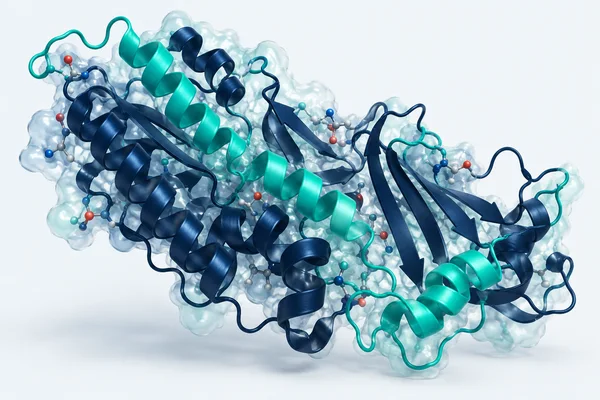
Coverage, disagreements and experimental context should accompany the synthesis.
One question, different layers of evidence.
Papers, molecular databases, files and notes live in different places. Connecting a question to its sources, checking identifiers and documenting the reasoning requires work that repeats across projects.
The urgency behind research
estimated new cases in 2024
estimated deaths in 2024
projected annual new cases by 2050
Global cancer estimates provide research context. They do not describe BioFlow’s market or demonstrated impact. IARC / GLOBOCAN 2024 · 08.07.2026 ↗
Research context throughout the workflow. Select a stage to explore.
01 / Ask
Define the question, terms and scientific scope.
What evidence connects BRCA1 to DNA repair?
Applications for research groups, laboratories and R&D teams.
Bring publications together and inspect support for each claim.
Search, retrieved passages and source references.

Connect symbols, records and literature while preserving entity identity.
Research context with explicit coverage and disagreements.
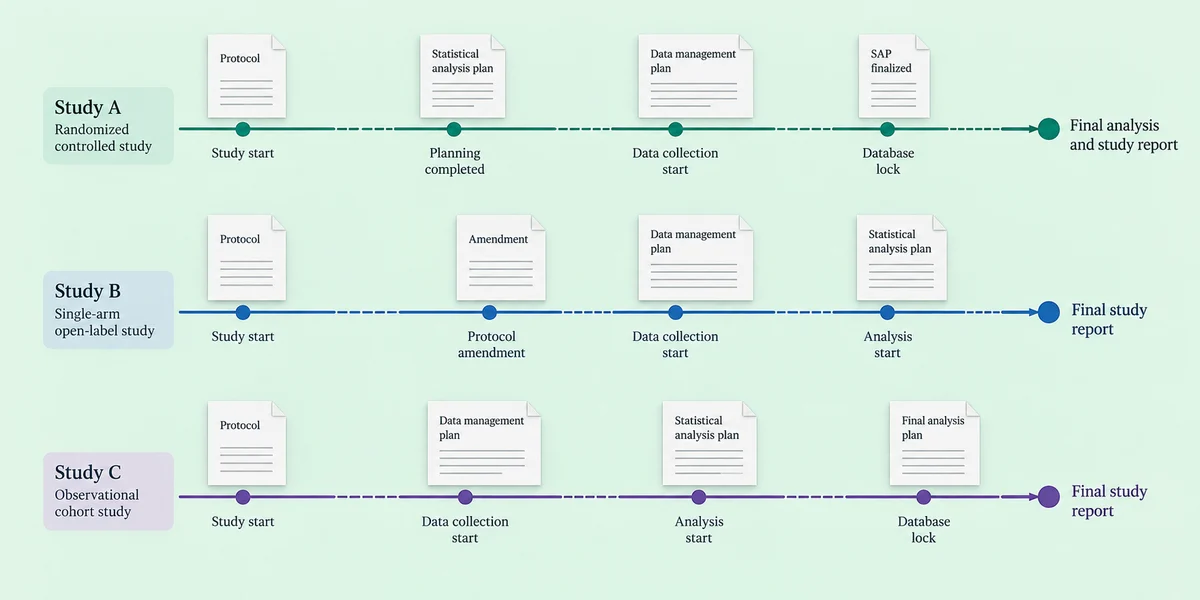
Organize questions about studies, criteria and research designs.
Proposed expansion. Integration and coverage need validation.

Explore small FASTA, FASTQ, GFF3 and VCF files.
Parsers implemented. BLAST needs local configuration.
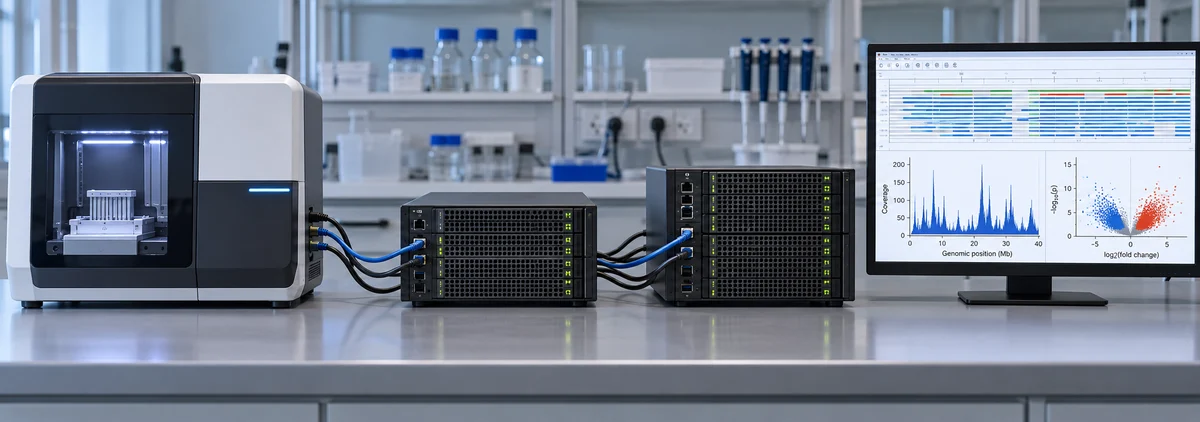
Keep questions and evidence close to analytical work.
Integration direction for Nextflow, nf-core, R and Python.

Record synthesis, identifiers and references for review.
Markdown reports implemented. Advanced collaboration under validation.
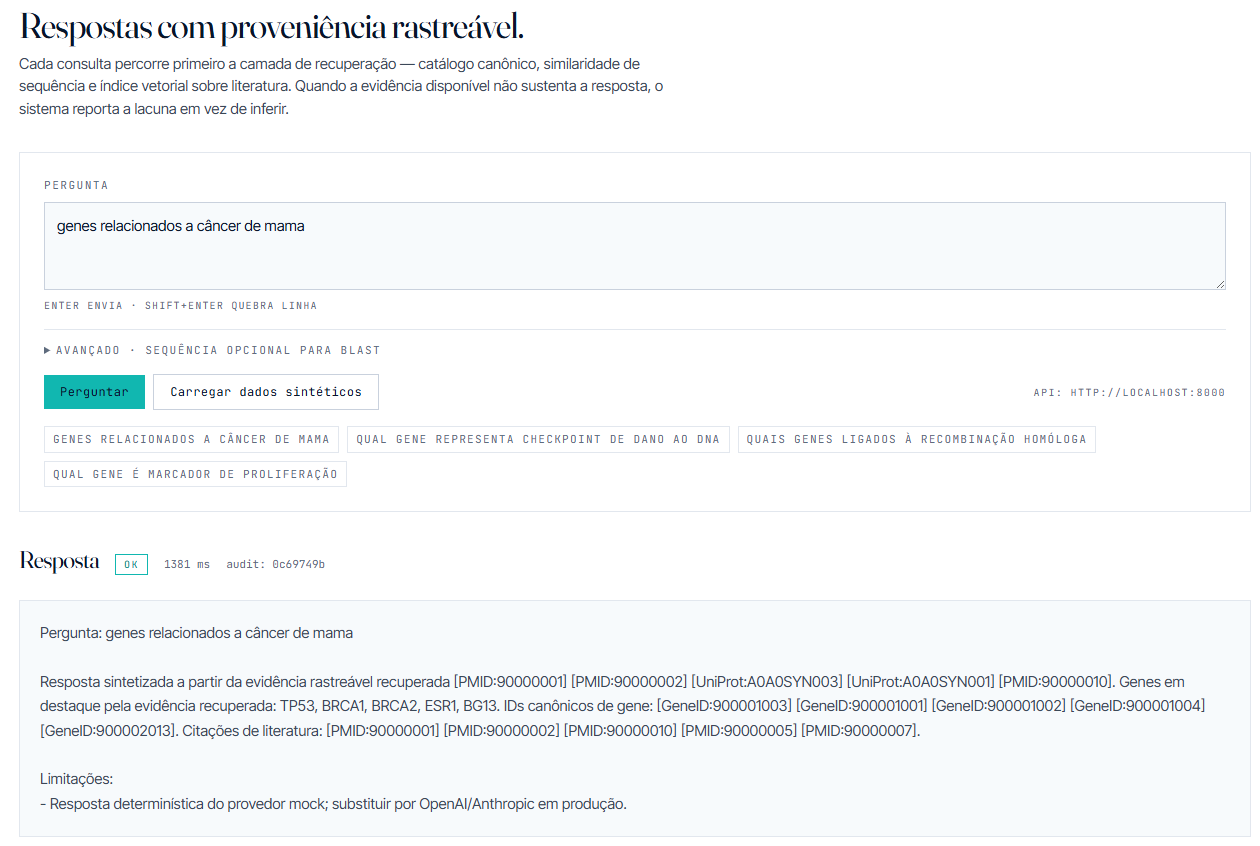
Real development captures recorded in the repository. This demonstration uses synthetic records identified in the interface.
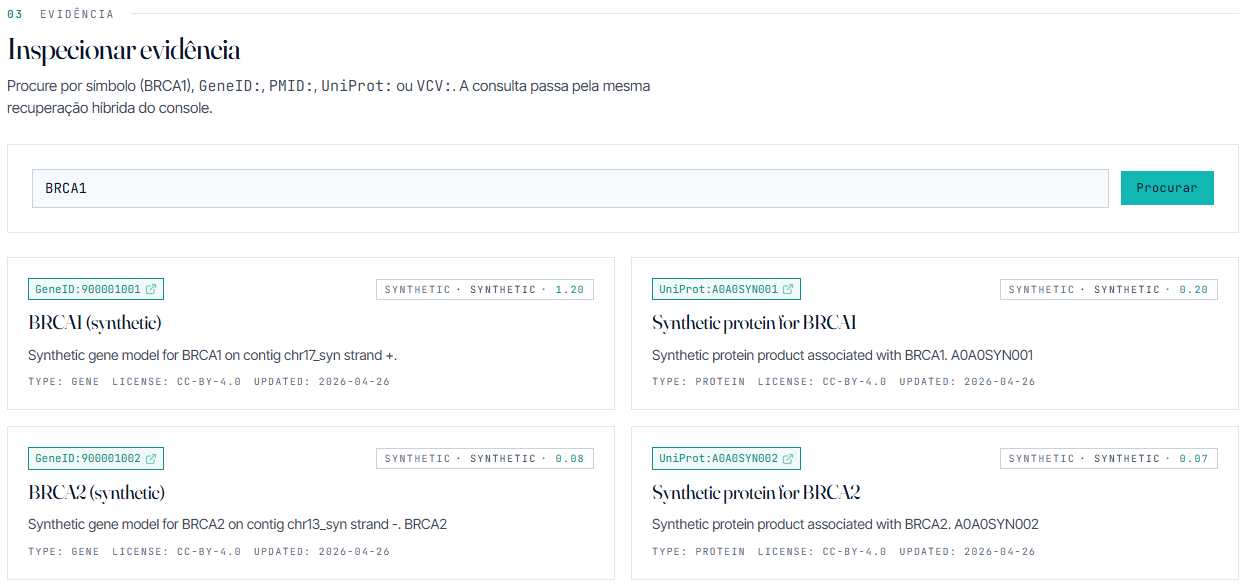
Access depth varies by source, license and configuration. Expand the groups to explore coverage.
PubMed, PMC OA, NCBI Gene, UniProt, ClinVar; FASTA, FASTQ, GFF3 and VCF parsers.
Europe PMC, bioRxiv/medRxiv, OpenAlex, Crossref and Open Targets in research workflows. gnomAD by variant; BLAST with local installation.
GEO, SRA, GDC/TCGA, cBioPortal, ClinicalTrials.gov and Ensembl; Nextflow/nf-core integration. FHIR, mCODE and OMOP require dedicated projects.
Source, identifier and passage accompany the synthesis.
Genes, variants and proteins gain consistent references.
Gaps and disagreements remain available for inspection.
Researchers and bioinformaticians explore questions and evidence.
The scientific lead defines scope and evaluation criteria.
Laboratories, institutes and R&D teams assess licenses and deployment.
A real question, an agreed set of sources and evaluation criteria defined with the team.
Agreed scope, sources, deployment and deliverables.
Proposed subscription for ongoing research work.
Access and deployment terms agreed with the institution.
Opportunity will be sized as eligible organizations × teams × licenses, or institutional contracts. Pricing, adoption and revenue still need commercial validation.
SCIENTIFIC VALIDATION
Develop a comparative study and publish a scientific paper on the tool’s effectiveness in biomedical research. The evaluation will examine source support for claims, evidence retrieval and identification of gaps, with independent review and reproducible methods.
Define questions, corpus, evaluation criteria and reference approaches before the experiments.
Evaluate BioFlow through independent review, quality metrics and error analysis.
Document methods, results and limitations and submit the work for peer review.
Synthesis requires human review. BioFlow is not a diagnostic or treatment recommendation system. Scientific quality, production deployment and proposed integrations require validation. Sources retain their licenses and access terms.
HackCancer brings together open education and collaboration. BioFlow is XFB Labs’ commercial evidence intelligence product. Each initiative retains its purpose and terms of use.
Explore HackCancer ↗XFB / Contact
A difficult question. A technology to explore. An idea waiting to take shape. Bring the challenge — let’s discover what is worth building.